The Road to Kathmandu: three questions I'm holding as Possible Now takes a step forward
Today I head back to Kathmandu for the Possible Now #ShiftThePower Global Summit. Here are three questions I'm carrying with me, and an invitation to think them through together.

Return to Kathmandu
In June 2025 I found myself in Nepal for one of the first Possible Now convenings. A question surfaced there that hasn't left me: what happens if we stop seeing ourselves as disconnected by geography, and start seeing ourselves as connected by shared purpose?
Eighteen months on, around 300 people have stepped into that question, in gatherings in Nepal, Kenya and the UK, and in many online conversations. From 2 to 4 December, many more of us meet in Kathmandu.
Before I go, I want to set down what I see Possible Now is becoming and the questions I'm holding. Partly to sharpen my own thinking. Mostly as an open invitation to argue with me.
Designing for coherence, not control
Possible Now grows out of #ShiftThePower, which since 2016 has centered new voices in the international development sector, exploring new ways of deciding and doing - asking who holds and uses power.
Global Fund for Community Foundations then began to ask another question: what is possible now?
Possible Now is a space, and a network of people, exploring that question together. What already exists that is working? How might we alt-scale what's effective? What else might be needed? And is a different way possible, rather than simply rebuilding what came before?
The landscape is shifting, and deep cuts to USAID and other aid budgets are part of that shift. But they are context, not origin: people across this network were building alternatives long before those ruptures happened. Suleiman Abdullahi named the deeper challenge: "the world is not short of courage or ideas. It is short of coherence."
Coherence here means many good efforts holding together long enough, and strongly enough, to change the status quo, without being co-opted or flattened. Possible Now starts from what is already alive: savings circles, mutual aid, community foundations, solidarity economies, diaspora giving and more. The work is to connect up the seeds of progress so that wins accumulate instead of evaporating.
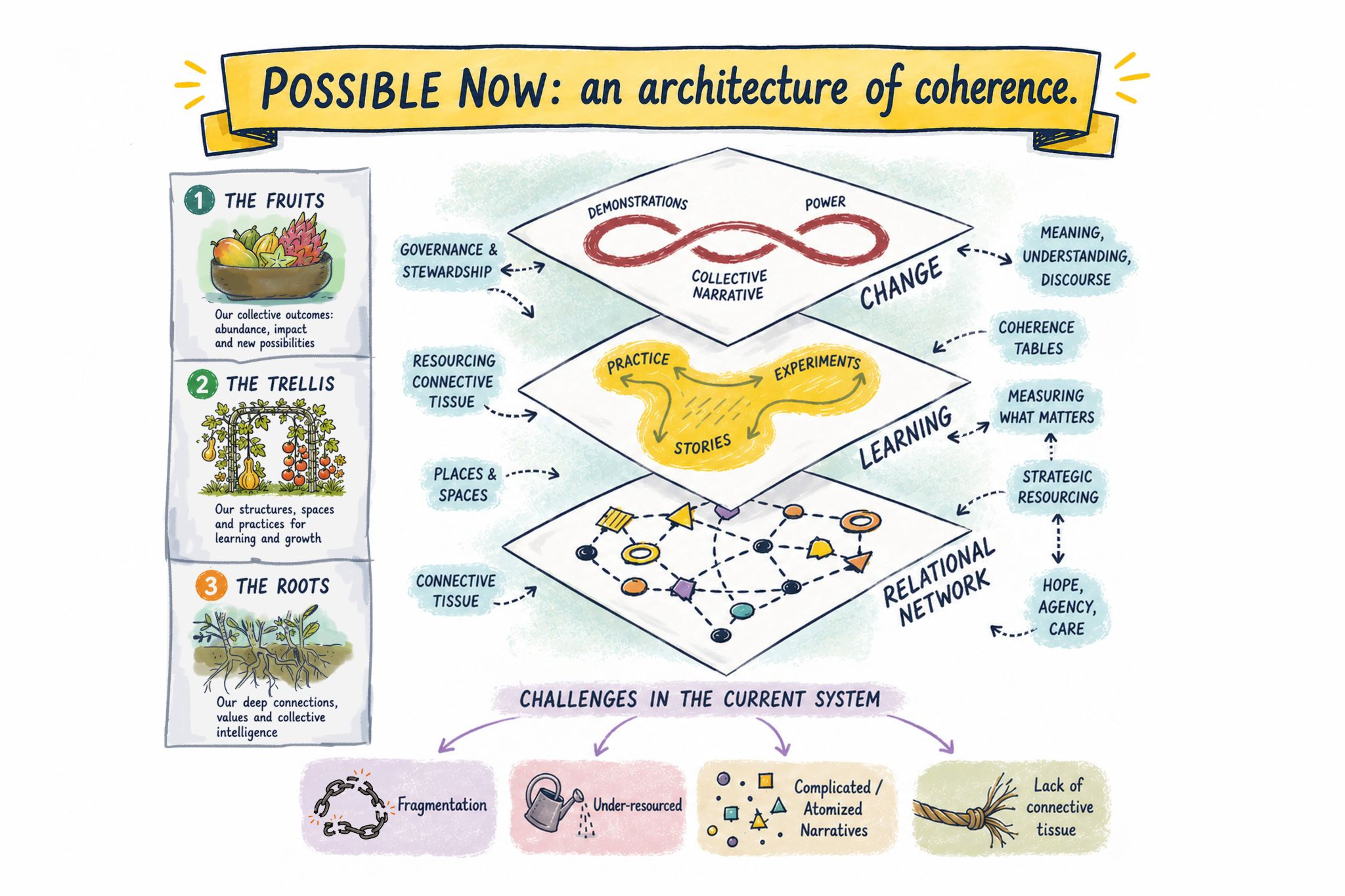
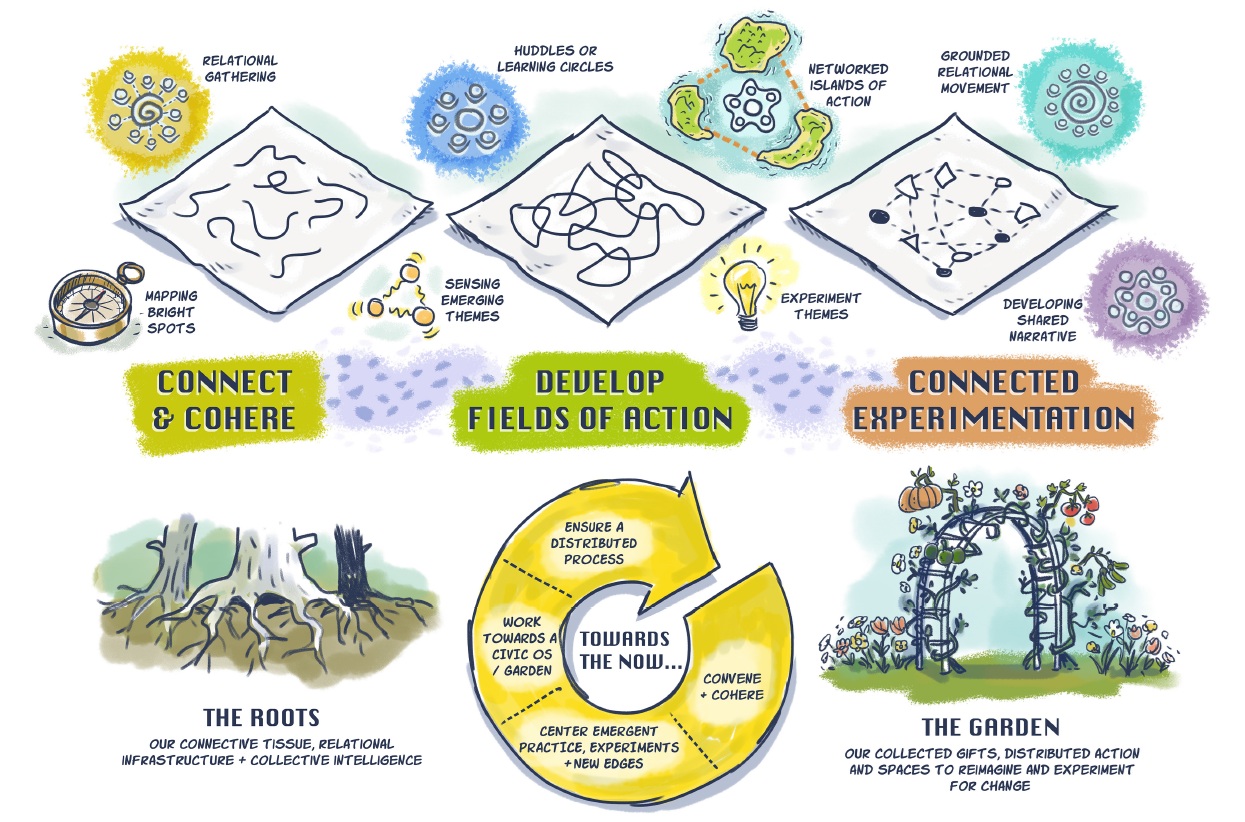
To do this, a number of us have been exploring the structures and processes needed to enable this kind of relational, system-shifting, boundary-spanning work. The structure we have been exploring has three layers we think of as a garden:
- The roots: a relational network of deep connections, shared values and collective intelligence. This is the connective tissue of a network and a movement.
- The trellis: the structures, spaces and practices where we learn together, through practice, experiments and stories.
- The fruits: collective change, through demonstrations of a new normal, collective narratives and collective power.
It is a response to four patterns in the current system: fragmentation, under-resourcing, atomised narratives, and a lack of connective tissue.
In practice, that looks like more than 30 Stitching Fellows exploring edge questions, from water as a commons to AI and power. It looks like group discussions that seek coherence rather than convergence, small catalytic grants, and an emerging effort to build collective intelligence and culture of care across it all.
I also shared a little about this at GFCF in September:
 Wendy Richardson 10 Sep 2026
The Road to Kathmandu
The Possible Now #ShiftThePower Global Summit runs from 2 to 4 December. It is the first #ShiftThePower summit in Asia, hosted by Tewa – the Nepal Women's Fund with GFCF and Accountability Lab Nepal. It follows Johannesburg in 2016 and Bogotá in 2023, which drew some 730 people from 77 countries.

As with previous summits, the design is deliberately not a conference of panels. The agenda is shaped by conversations rather than expert presentations: weaving conversations, community-building activities, a poster session, an anytime studio and a poetry garden. It's a space to explore everyone's different context for what is possible now.
Bogotá generated enormous energy, but energy alone doesn't always hold. The question underneath all three of my enquiries is what connective tissue could sustain, and organise power, between these larger gatherings.

Three areas to explore
1. How might a dispersed global network build collective intelligence across difference, geography and topic?
Possible Now's knowledge is everywhere and nowhere. It lives in a Fellow's conversations with local crisis responders across twenty contexts, in a Coherence Table on the good economy, in a WhatsApp thread. Daniela Cevallos, one of the Fellows, is drawn to the stories that linger after workshops end: the ones shared over meals or on the bus ride home. That is where much of a network's intelligence lives, yet there is a risk of it being fleeting and not commonly held.
The range is part of the challenge. Fellows are exploring water as a commons in Argentina, economic citizenship in Kenya, futures thinking from inside wartime Ukraine, and traditional festivals in Brazil as collective resourcing. No one can be in every conversation. So how does a network learn as a whole without flattening what makes each piece true?
I've been working on a small first answer - prototyping a kind of collective memory for Possible Now. More about that in the future.
The principles matter more than the tools:
- Relational intelligence first. Patterns are prompts for people to make sense of together, not conclusions.
- Sovereignty as a foundation. Data and knowledge sovereignty, including Indigenous data rights through frameworks like CARE and OCAP, shape what is gathered and how.
- Surfacing, not automating. The aim is to help us see across the network, not to give away our power of judgement and critique.
The image I keep returning to is Zellij, the North African mosaic that Yousra Semmache and Otros Futuros are using to assemble a "lateral universalism" from many traditions. Each tile stays distinct. The pattern only appears when they sit together.
Edges I'm exploring:
- What does Possible Now need to know together, and what should stay local?
- How might patterns be offered back so they invite disagreement, not just agreement?
- Who owns a pattern once the network has seen it?
- Can new or old technologies help us see more, and where do they smooth out the very differences we need?
2. How far does relational practice extend, and how do we keep weaving as the network grows?
Relationships have frequently been cited as community organisations' greatest asset, and we believe Possible Now is the same. When we held sharing circles with the network in 2025, a clear theme was that its strength lies in relational infrastructure built over decades, more than in financial capital. The same conversations surfaced a harder truth: relationships don't scale infinitely.
Intimacy has a size. A circle of eight or nine can hold a real conversation; a summit of hundreds can't hold it in the same way. As the network grows through Fellows, tables, the Summit and the people each of us brings, the question becomes what stitching looks like when you can no longer know everyone.
Kathmandu is partly a live test. Fellows who have been deep in conversation for months will meet people arriving fresh, many from institutions with their own habits. Our working principle is to meet people where they are, then help them move where they believe they need to go.
Some threads I'm following:
- Weavers. Connective labour is too often treated as overhead. If stitching is the infrastructure, the stitchers need to be resourced and recognised as such, and the Fellowships are one experiment in that.
- Mycelium, not pyramids. Rather than one big network, perhaps many small, dense circles with loose ties between them. More meshwork than org chart.
- Protocols that carry care. At Taala Foundation, Severus Hama-Owamparo is co-designing a Reciprocity and Return Protocol, asking what we owe someone who has trusted us. Agreements like this let trust travel further than any one relationship.
- Places. Kedolwa Waziri's fellowship treats space itself as an organiser and as relational infrastructure. Tewa is that kind of place for many of us.
The question of a "home" for this work keeps coming up, along with the fear of answering it with yet another institution. My current hunch is that the home might be a revolving caravan of gatherings. People join and leave, and caravans set off in different directions. There is potentially many special places which can provide 'bricks and mortar', but the power of Possible Now is something you carry rather than a building you maintain.
Questions I'm holding:
- What is the right unit of relational practice as we grow: the circle, the cluster or the place?
- How do relationships stay warm between gatherings?
- How might we resource weavers without turning stitching into a job description that loses its soul?
- What does it mean to identify with Possible Now when you can't know everyone in it?
3. What do systems change, transitions and social innovation offer Possible Now, and who should walk alongside?
My own roots are in social labs, community development, social innovation and transitions research, so I hold this one with some self-awareness. These fields bring real gifts - they offer language and practice for how change happens, decades of patterns about how alternatives grow from the edges, and ideas like 45-degree change, where organised communities meet sympathetic insiders. They also carry some legitimacy in rooms where Possible Now needs to be heard.
They carry risks too. In October, Barry Knight, Jenny Hodgson and I convened a small group at Mary Ward House in London to ask how networks build coherence without control. One person observed that everyone talks about system change, but few can say what is meant to change. Others worried that "relational infrastructure" could follow "co-design" and "partnerships" to become empty jargon without sustained focus.
A real tension surfaced in that room too. One view says create the conditions and trust what emerges. Another says opponents are organised and ruthless, so we must deliberately build power. I don't think Possible Now has to choose, but it does need to hold both honestly.
The deeper question is whose knowledge sits at the centre. Possible Now spans many cultures and many ways of knowing, being and doing. Gastón Chillier's fellowship asks what happens when the professional repertoire of human rights stops occupying the centre and meets other ways of knowing on more equal terms. I'd ask the same of systems change and transitions theory.
What I'm reaching for is an ecology of knowing. Lived experience, culturally specific practice, ancestral and spiritual wisdom, practitioner know-how and research, in relationship with each other, none of them the default. Over time, that ecology could become Possible Now's long memory: a living source held on the network's own terms, not an archive owned by someone else.
And academics? I'm have one foot in that camp, sort of: an edge-dweller inside a university. Many at Mary Ward House described the same feeling. Universities offer legitimacy, time and access to ideas, but also sometimes have a complicated history of extractive research practices. Practitioners are often doing the work without the framework, while academics sometimes hold frameworks without relatable language. My hope is that Possible Now could create coherence between the two. As a Somali proverb Suleiman Abdullahi shared puts it: how do you chew something tough and keep your teeth?
Barry's new book, A New World is Rising, is one model. It is rigorous research offered as a trellis rather than a framework, and open access to anyone.
So yes, I think academics can walk alongside, if we walk alongside rather than ahead. That might mean communities holding the resources, with researchers as junior partners. It might mean making community practice visible without making it universal, and using an institution's standing to protect and legitimnise edge work.
Questions I'm holding:
- What is the value of these fields to Possible Now, and to whom? How do we make them applicable and relatable?
- How might the network's own language lead, with theory coming alongside?
- What would consent, attribution and return look like for knowledge shared across Possible Now?
- What would it take for academics to be useful companions rather than see themselves as experts or guides?

Carrying the questions
I'm not going to Kathmandu for answers. These are questions to carry into weaving conversations, long lunches and the corridors in between, and to be changed by the people I meet.
Barry has suggested that after Nepal the work shifts from what is possible to what might become probable. I suspect these three questions sit right on that hinge: how we learn together, how we hold each other as we grow, and whose knowledge we build on.
I'll write up what I learn when I'm back.
One ask
If you've seen a network do any of this well, send it my way. I'm especially keen on networks that learn across difference, keep relationships alive at scale, or bring researchers alongside without capturing the work.
Keen to connect?
If you're coming to Kathmandu, find me. I'd love to hear where these questions land for you, and what I'm missing. If you're not, a message on LinkedIn or a reply here works just as well.