The Physiology of Trust and Co-creation - Relational Infrastructure Part III
What is happening inside our bodies and between us, when relational infrastructure is taking root and growing? What is the physiology of trust and co-creation?


We've all felt it. The slow realisation that trust is building between ourself and someone else - or perhaps a group of people. The back and forth as we are able to see that with that trust, we can be more collaborative - more co-creative together. Sometimes it can happen fast, and sometimes it takes months to really bed in.
Lately I've been curious about the physiology of what is happening - I guess because I'm wondering how we can go beyond declaring a 'safe space', but instead design for it, creating experiences and processes which enable us to build relational infrastructure in more efffective and enduring ways. Perhaps it's the rise of AI, but with this "machine intelligence", it makes me all the more curious about the evolutionary biology of "relational intelligence".
Where it began: limbic resonance
Let's take a step back. At the beginninng of the year I shared that my annual guiding word was 'Resonance'. As I started unpacking that, I stumbled on the idea of "Limbic Resonance" - the idea introduced by Lewis, Amini & Lammon in A General Theory of Love (2000) - basically that we have a deep, neurological capacity for sharing deep emotional states with another person.
As I delved a bit deeper, I learnt that whilst that capacity exists, the science has moved on around the limbic system, and instead we might now understand this through scientific concepts like inter-brain synchrony (IBS), neural coupling, interpersonal co-regulation and attunement.
This post aims to simplify and translate those terms a little for 'the rest of us', so that we can explore the implications of this physiology for how we design, facilitate and enable the building of relational infrastructure over time, in group and network environments. To what end? Well as I said in the original relational infrastucture post and this more recent one - this work is about reconnection, belonging, overcoming challenges, building resilience, and creating sustainable social, economic, and environmental value.

Personal physiology and the science of between-ness
The idea of "Trust" and trust building is often thrown around in innovation and collaboration contexts - "move at the speed of trust" is a classic in the social innovation realm for example, but many organisational contexts almost entirely ignore the role of building teams and cultivating trust instead opting for productivity frames like 'kick off meetings'. In more mature and advanced processes and programs, such as some fellowships, labs or sangha, more attention is often focused on creating a shared container, navigating power, and utilising the likes of storytelling for whakawhanaungatanga // building a sense of family or belonging.
But what's happening inside the body at a personal, intra-personal or collective scale? Well modern neuroscience and organizational psychology demonstrate that trust is fundamentally a physiological state and relational capacity.
When nervous systems feel evaluated, unanchored, or uncertain, brain activity shifts toward threat detection and self-preservation. In this state, participants default to institutional posturing, risk aversion, and transactional communication.
To unlock higher-level interaction and - by association - the ability to create together, we must establish relational, psychological safety: an environment where participants move out of defensive modes and into collaborative curiosity.
So I dived into the science and have attempted to summarise here. Essentially there are five intra-personal dynamics at play with trust and co-creation work:
- Co-Regulation & Relational Safety
- Embodied Action & Kinematic Alignment
- Distributed Cognition & Boundary Objects
- Collective Intelligence & Generative Emergence
- Inter-Brain Gamma Synchrony & Collective "Aha!" Moments

I. Co-Regulation & Relational Safety
- The Science: Inter-Brain Synchrony (IBS), autonomic entrainment, and affective trust form the physiological basis of psychological safety. When neural threat-detection networks drop their guard, individuals shift from defensive self-preservation to genuine empathy, enabling high task conflict without triggering personal relationship conflict.
- In Practice: We can deliberately design environments for sensory grounding and processes which support emotional safety early - lowering nervous systems to open up the relational capacity needed for open, vulnerable communication across boundaries and power dynamics.
- Example activity/prompt: small group share - what lived experience or personal story brought you to care about this topic? Second, what is one thing you hope you don't have to pretend to know or be perfect at during this initiative?
II. Embodied Action & Kinematic Alignment
- The Science: Cognition is downstream of embodied action ("acting into thinking"). Physical co-creation activities can activate predictive motor loops, shared gaze, and joint perceptual attention, bypassing intellectual posturing and converting individuals towards aligned understanding.
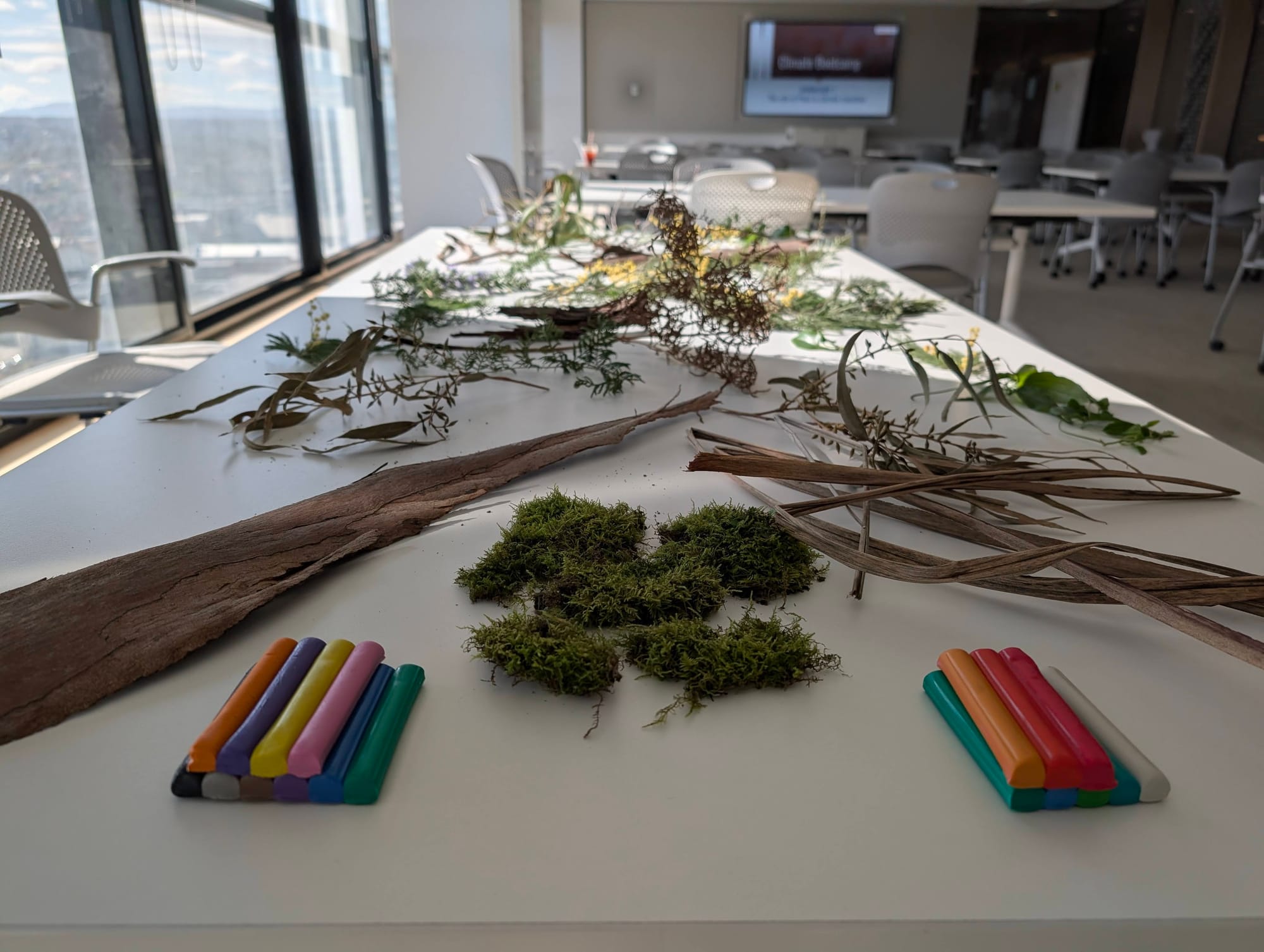
- In Practice: Replacing static, text-heavy debates with spatial and movement-based activities - immersive environments such as site walks, creative prototyping, and spatial activities and enabling shared focus on physical, real-time action.
- Example activity: small group co-creation - as a group, develop a multisided shape with key images to represent the key aspects of the challenge, and then make a spatial representation of your proximity and commitment to the challenge.
III. Distributed Cognition & Boundary Objects
- The Science: Groups optimise cognitive processing by offloading memory onto shared physical artifacts and simplified memory networks ("who knows what"). Simultaneously, interactive language alignment and "boundary objects" allow diverse stakeholders to interpret a single prototype or visualisation through their own disciplinary lens while maintaining a coherent shared focus.
- In Practice: Centering workshops and similar experiences around externalised visualisations and flexible physical models, establishing shared shorthand to bridge jargon and hold complex system states in open view.
- Example activity: whole of group warm data lab small group discussions, followed by graphic facilitation of the reflections and weaving of ideas. The final product being a visual image of the interconnected ideas and linkages.
IV. Collective Intelligence & Generative Emergence
- The Science: Group learning and collaborative capacity (the collective c-factor) is not determined by individual IQ, but by conversational turn-taking, high social perceptiveness, generative listening and communicative equity. When these alignment conditions are met, group output becomes non-linear.
- In Practice: Using micro-facilitation protocols that guarantee balanced airtime, actively monitor non-verbal social cues, and curate low-stakes creative risks to turn diverse stakeholder inputs into novel, emergent solutions.
- Example activity: Utilising peer generative listening practices, such as u-Lab's Case Clinic create a facilitative structure which practices forms of listening, sharing, turn taking, emergent conversation and reflection.
V. Inter-Brain Gamma Synchrony & Collective "Aha!" Moments
- The Science: Hyperscanning studies during joint creative problem-solving show that shared moments of insight (the collective "Aha!" moment) trigger inter-brain Gamma-band oscillations ('neural burst'), particularly across temporal and prefrontal regions. When one person articulates a novel framing that clicks, this high-frequency neural burst spreads rapidly to listening brains. This neural alignment triggers a simultaneous release of dopamine in the part of the brain which identifies rewards, registering physiologically as shared delight and accelerating concept adoption across the room.
- In Practice: Structuring ideation around open, incomplete challenges rather than polished pitches, allows the group to arrive at the "Aha!" moment together so the neural resonance and dopamine reward are shared collectively.
- Facilitation Prompt: The "50% Incomplete Storyboard" - present pair with a storyboard showing a community member encountering the challenge - but the story stops halfway through. In pairs, the task is to draw and complete the final two panels together. Co-draw on the same paper at the same time.
Implications and ponderings
For me, there's something really interesting about delving into the physiology of what's happening in these experiences I've been involved in over the last 15+ years - some as a participant, some as a facilitator.
My hope is that as we better understand what is happening at the personal mind-body level, as well as - more interestingly for me - between people, we can better design for meaningful connection and co-creative capacities. This isn't about speeding things up - some kind of hacking of the relational code to enable us to be more productive. This is about creating the spaces and experiences for relational depth.
One thing that's been ticking along in the back of my mind, is whether - knowing a little more about the physiology - whether we could somehow identify indicators that a group is growing in their connectedness and collective creative capacity? Could we chart and visualise this over time to help the group see it's progress, help facilitators tweak their experiences, convince key stakeholders that the process is working (or not!) and to continue to support?
I am interested in whether we can better understand how ideas and creativity move in groups - what makes the group smarter together (collective intelligence), and what inhibits these processes of aliveness? If we were to augment human intelligence with machine intelligence, when should we bring that into the group consciousness - or should it happen outside of the process in the days and weeks after?
To be explored....?
Are you exploring this work? Please do get in touch!