Bloopers: Living Labs Report - Part 1: Generations
Living Labs are evolving over time, geography and in response to the challenges and opportunities for collective action. This post introduces Three Generations of evolution.


This is Part 1 in a series of posts after the publishing of 'Advancing University Living Labs: relational infrastructure for transformative impact', with some outtakes which didn't make the final report, but I still want to share.
Context
What are Living Labs? Simply put, they're platforms for change; bringing together people from across government, business, civil society, academia and more, to co-create ways to address the challenges of our time.
Find out more:


Shift in Focus
One of the key shifts we made along the way with the report, was moving from a broader view of Living Labs as a field of practice, to a specific focus on University Living Labs, as an institutional infrastructure which orchestrates and integrates activity from across the large decentralised cluster of organisations we call a university.
This shift made sense, but it left me with various ideas and frames which no longer fit the mould.
The Outtakes
The Generations of Living Labs
For transparency, the following wasn't developed from rigorous research analysis - it was reflection and sensemaking across some of the gradual shifts I saw when I looked back at the characteristics of older living labs, a transition and evolution in Europe, and what I was seeing as contemporary approaches.
Originally I was focused on three main generations, with the sense that a fourth generation was emerging. I hope to write a little more about that generation in a future post in the series.
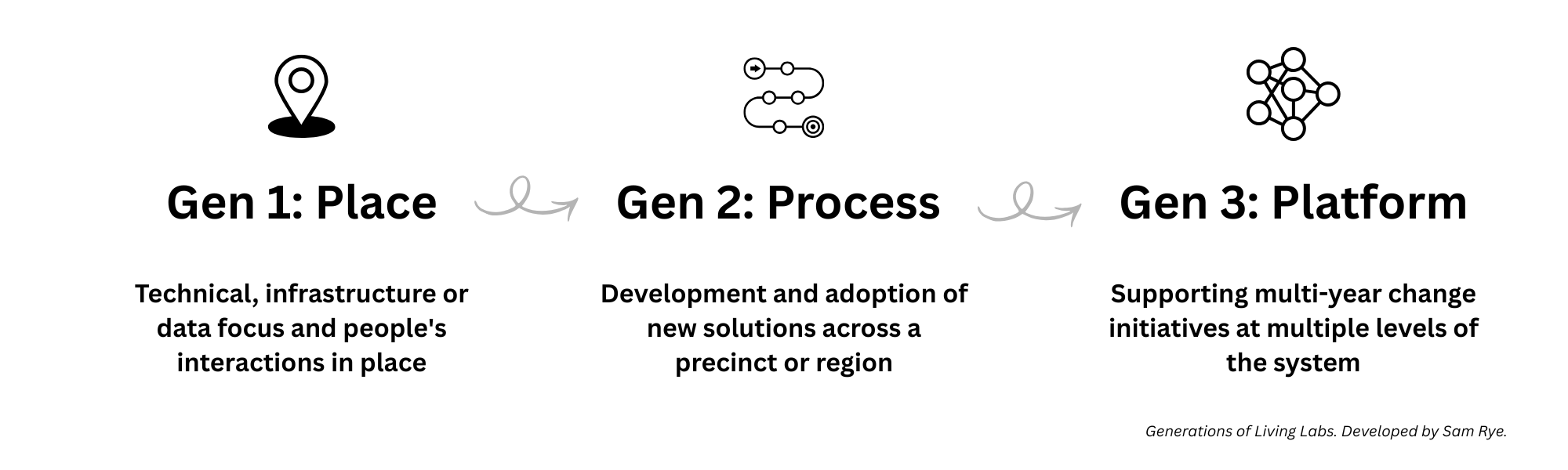
The following table aims to lay out some of the detail of the general characteristics I was seeing in each generation. These aren't meant to be hard and fast, and of course many labs may be a blend of elements across generations as they advanced practice, structures and more was possible.
The table below spans beyond the page limit (working on a better way to show this), so you might need to scroll left to right to uncover the detail in each generation.
|
Lab Generation |
1st Generation |
2nd Generation |
3rd Generation |
|
Guiding approach |
Place |
Process |
Platform |
|
Typical activity focus |
Technical, infrastructure or data focus and people's interactions in place. Example: introducing new sustainable building technologies and energy use patterns in a specific building. |
Development and adoption of new solutions across a precinct or region. Example: developing new services and literacy programs with town residents to shift energy demand. |
Supporting multi-year change initiatives at multiple levels of the system. Example: addressing energy transitions in a region (or in multiple regions) through policy, infrastructure, institutional change, new services and products and community adoption. |
|
Direction & decision making |
Owned and governed by a single organisation or close partnership |
Stewarded by a single organisation, direction enriched with consultation / participation from stakeholder groups |
Co-governance approach, directing the lab activities from across quadruple helix with the ‘power of no’ for all parties |
|
Funding model |
Single funding type (e.g. project grant) |
Dual finance, such as leveraged funding (e.g. philanthropic and research funding) |
Blended finance (such as systemic investing approach), with varied business models potentially including revenue generation from solutions or service offerings. |
|
Longevity |
Run and done - closed after a period, such as 2 years |
Longer runs (~4-10 years) with some forward flow on for ecosystem (e.g. agenda carried by another organisation) |
Platform for systemic change work with enduring and evolving agenda, with enduring support and high levels of embeddedness and/or stability to catalyse change processes over time. |
|
Innovation approach |
Innovation management - e.g. funnel of ideas, tested with users, to result in a better product or service |
Open innovation / innovation networks |
Open collaborative innovation ecosystem, societal transition arenas, intermediary for mission approaches or challenge-led innovation |
|
Evaluation approach |
Retrospective evaluation of: 1) Solution outputs based on narrow parameters (e.g. end user usage, satisfaction etc) |
Retrospective evaluation of: 2) Solution outputs/outcomes |
Open and ongoing evaluation (such as through reflexive monitoring and evaluation) of multiple aspects: 3) Initiative/Solution outcomes - assessing 6 capitals (or other framework) generated by the initiatives/solutions generated within the lab. |
|
Primary sectors involved as partners |
Business. Universities and research institutions. |
Government. Civil Society. Universities and research institutions. Business. |
Transition Networks & Catalysts. Government. Civil Society. Universities and research institutions. Business. |
Conclusion
I'd be interested to hear whether these generations resonated at all with you, if you work in or proximate to the living labs space.
I'll continue to explore this work through Monash University, as well as through the ENoLL network and beyond.
I have a few more posts up my sleeve for this series, so stay tuned if this interests you.