Trojan Mouse. Trojan Mice!
About a decade ago, I heard the term "Trojan Mouse" as a way to speak about small experiments or safe-to-fail tests. Ever since I've been thinking about what their role is in systems change.


I got thinking about the role of small scale experimentation and its role in systems initiatives whilst co-leading a social innovation lab in Aotearoa NZ. Initially we used the language of prototyping, and latterly experimentation, but I've always really loved how evocative "Trojan Mouse" is as a term.
I'm pretty sure it was Jackie Mahendra's article which tuned it into my consciousness:
 Jackie Mahendra
Trojan Mice: One way to make risk-taking more palatable for social change organizations is to run small, light, nimble experiments – tests not built to win wars, but rather to quickly infiltrate new territory, attack new problems, and inform future tactics.
What's The Pont also offers 5 Types of Trojan Mice in this post, which I think are worth sharing:
- Obvious: try something you think will work
- Oblique: try something from 'left field'
- Naïve: challenge assumptions by trying something which might seem naïve or daft
- Conflict: try something which is opposite to the obvious good ideas
- Failure: try something designed to fail and provide unexpected learning
As I explored the idea, something kept coming back to me. What is it about the idea of a Trojan Mouse which seems so compelling, but different somehow to "prototype" or "experiment"?
After quite some percollation and going back to the original trojan horse story of Troy, I realised it's the use of an outer shell (the ruse or gift) with something else inside (the deception or surprise). So this makes me think that if we're really using the idea of a Trojan Mouse faithfully, we need to be thinking about them not just as "small, light, nimble experiments", or even as something from which we can learn - but actually as subversive efforts which unlock or enable something larger to happen.
How about a slight reframe then:
A Trojan Mouse is a small, sometimes inconspicuous effort that solves an immediate, localized problem to bypass resistance, while introducing a new cultural logic, capability or experience that, once accepted, contributes to unlocking the necessary conditions for systemic change.
How about we don't use this gem of a term for "any small thing we do which we want to learn from", but use it with more intention about it's potential for unlocking broader change?

Mouse → Mice
The other thing I find fascinating about this idea is the size and shift from singular bigger experiments (like a Trojan Horse) to potentially more smaller experiments, prototypes or efforts.
Both Harold Jarche who was one of the first articles online about this, and What's the Pont both pluralise too...
Harold Jarche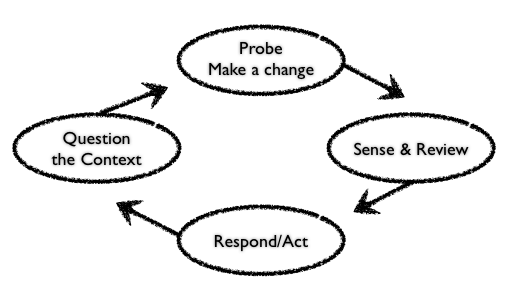
 Reply
Reply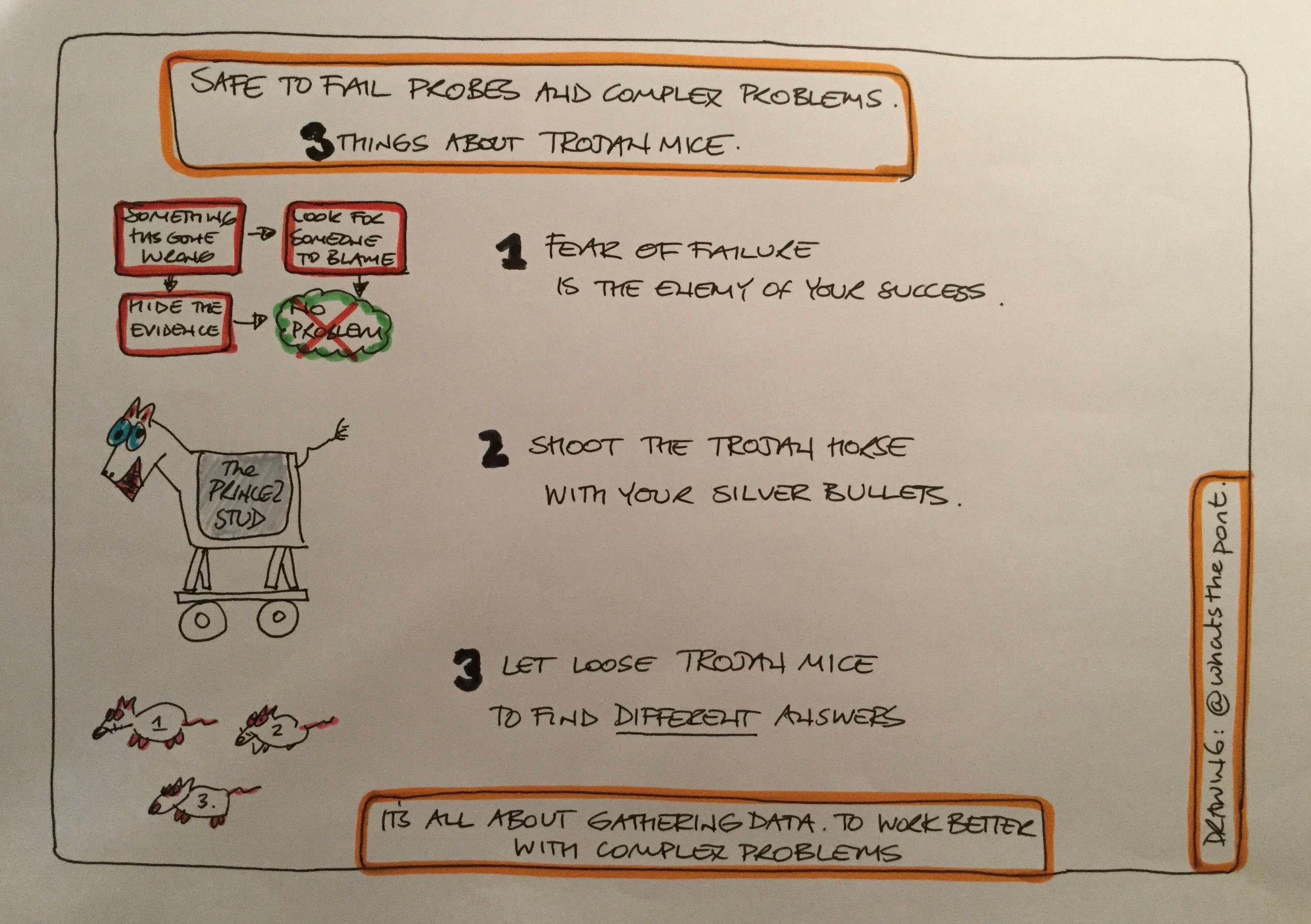
We know that in systems change and transitions work (my primary area of interest) that small shifts can create larger impacts. Change is not a linear sport, and sometimes we need multiple coordinated shifts to unlock bigger change. We sometimes call that a 'portfolio approach' - and it can be utilised in large scale challenge-led approaches, as well as more targeted systems change approaches.
Art imitates life
As we know, we have a habit of humans immitating what ecological relationships have already evolved to do, and thinking we have invented something new.
So what do mice do in their normal ecological niches?
Well they are both predator and prey, and they play a really important role in spreading seeds and spores of fungi, and they also change the composition of the soil by digging tunnels and mounds making it more porous and helping water soak in and prevent floods.
What can we take from this? What are the parallels with our trojan mice idea?
- Spreading ideas and new norms
- Breaking down what isn't useful any more
- Making systems more porous and fluid
- Some will be consumed and not return

Wrapping Up
I like the idea of Trojan Mice being slightly different to any experiment, prototype or effort which is small - instead as something which may be subversive, and/or unlock greater possibility.
I'm always interested - does this resonate at all? How do you use the term? Have you set loose any Trojan Mice lately?
And for my living lab & social innovation lab crowd - do you think Trojan Mice are the same as "urban experimentation", prototypes and the likes which you use? What else can we learn from the idea?
Assistance
I went a bit wild and chocked together some favourite sources about Trojan Mice, experimentation and more into a NotebookLM notebook - you can engage with that here if you're interested.
This post is made with a small amount of assistance of NotebookLM to compare and contrast sources, and here's their visual depiction of the notebook themes:
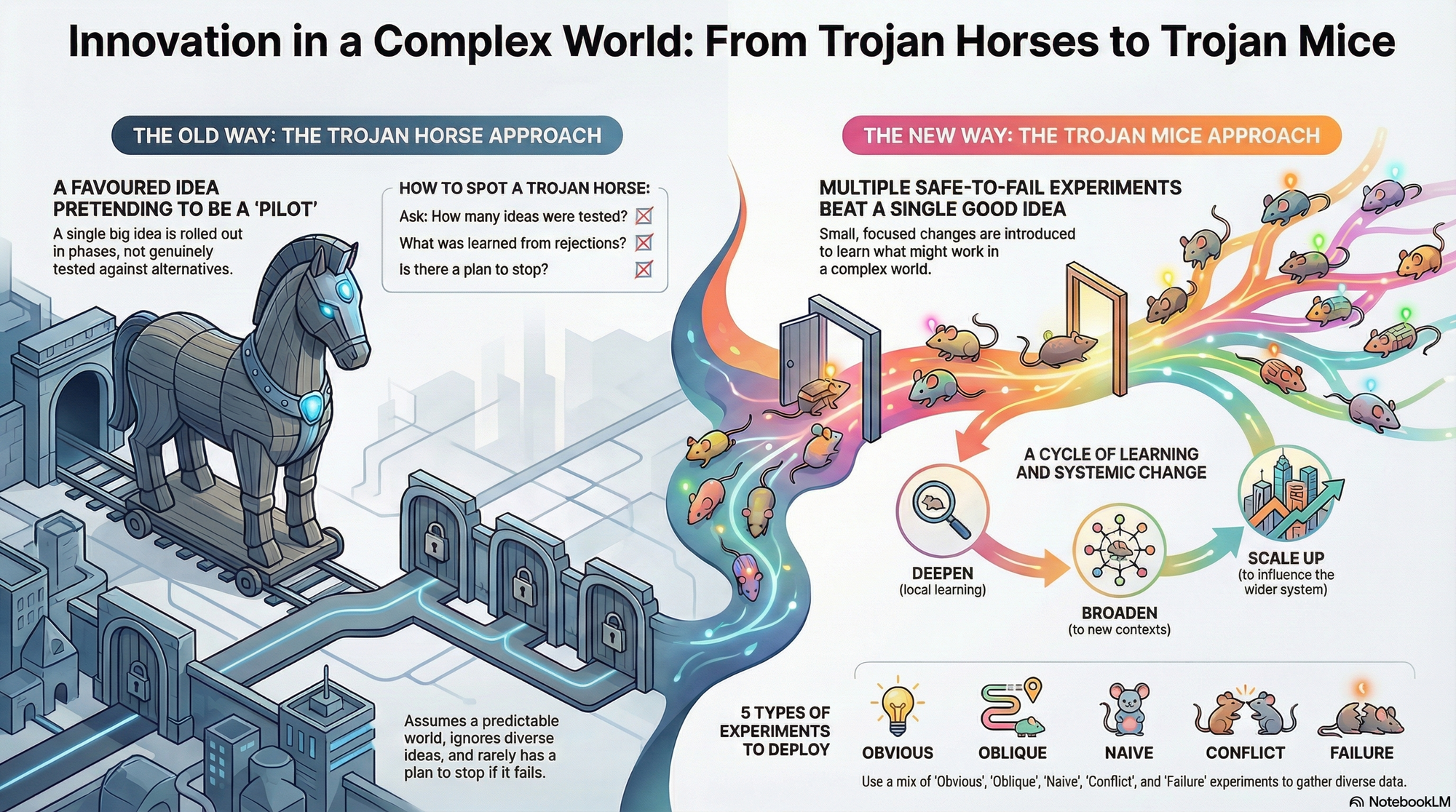
References
Berwick, D. M. (2023, May 17). K4: Really, really big change: How leaps happen when steps will not do [Presentation slides]. IHI-BMJ International Forum on Quality and Safety in Health Care, Copenhagen, Denmark.
Bevan, H., & Henriks, G. (2017, February 16). Creating tangible outcomes in large scale change and transformation projects [Presentation slides].
Bolton, C. (2013, November 10). Trojan horses are not Trojan mice: 5 questions to spot the difference. What's the PONT. https://whatsthepont.blog/2013/11/10/trojan-horses-are-not-trojan-mice-5-questions-to-spot-the-difference/
Bolton, C. (2020, February 9). Trojan mice in 900 seconds. What's the PONT. https://whatsthepont.blog/
Centre for Public Impact. (n.d.). Trojan mice experiments.
Christiansen, J., Quaggiotto, G., & Leurs, B. (2017, March 6). Towards an experimental culture in government: Reflections on and from practice. Nesta. https://www.nesta.org.uk/blog/towards-an-experimental-culture-in-government-reflections-on-and-from-practice/
Cynefin.io. (n.d.). Safe to fail probes. Retrieved from https://cynefin.io/index.php?title=Safe_to_fail_probes
Dijkstra, A. M., & Joore, P. (2025). The urban living lab way of working handbook. Amsterdam Institute for Advanced Metropolitan Solutions.
Evans, J., Karvonen, A., & Raven, R. (Eds.). (2016). The experimental city. Routledge.
Giganti, P., & Falcone, P. M. (2022). Strategic niche management for sustainability: A systematic literature review. Sustainability, 14(1680). https://doi.org/10.3390/su14031680
Jarche, H. (2012, October 15). On Trojan mice. Harold Jarche. https://jarche.com/2012/10/on-trojan-mice/
König, C. C., Saes, M. S. M., & Schnaider, P. S. B. (2024). How and why did the transition process towards a fully sustainable production of cocoa beans in Bahia (Brazil) take place?. International Food and Agribusiness Management Review, 27(3). https://doi.org/10.22434/IFAMR2023.0049
Luederitz, C., Schäpke, N., Wiek, A., Lang, D. J., Bergmann, M., Bos, J. J., Burch, S., Davies, A., Evans, J., König, A., Farrelly, M. A., Forrest, N., Frantzeskaki, N., Gibson, R. B., Kay, B., Loorbach, D. A., McCormick, K., Parodi, O., Rauschmayer, F., … Westley, F. (2016). Learning through evaluation - A tentative evaluative scheme for sustainability transition experiments. Journal of Cleaner Production. https://doi.org/10.1016/j.jclepro.2016.09.005
Mohr, R. (2019, March 22). Podcast: Experimental, multi-disciplinary approaches to systems change and social innovation: Interview with Sam Rye. In Too Deep by Kumu. Medium.
Novalia, W., Raven, R., & Farrelly, M. (2026). The spatial dynamics of urban experimentation: A novel framework for recontextualisation across places. Cities, 170, 106682. https://doi.org/10.1016/j.cities.2025.106682
Raven, R., Sengers, F., Spaeth, P., Xie, L., Cheshmehzangi, A., & de Jong, M. (2019). Urban experimentation and institutional arrangements. European Planning Studies, 27(2), 258–281. https://doi.org/10.1080/09654313.2017.1393047
Rodrigues, A. C., Cubista, J., & Simonsen, R. (n.d.). Prototyping our future: Social labs for a sustainable, regenerative, & thriving future. prototypingourfuture.info
Rye, S. (2019, June 27). Towards targeted systems change. Medium.
Rye, S. (2021, September 12). Obscuring complexity & welcoming trojan mice. Fieldnotes by Sam Rye.
Rye, S. (2023, October 16). Furthering experimentation practice - Part I. Fieldnotes by Sam Rye.
Rye, S. (2023, October 20). Furthering experimentation practice - Part II: Process & pathways. Fieldnotes by Sam Rye.
Schot, J., Kivimaa, P., & Torrens, J. (2019). Transforming experimentation: Experimental policy engagements and their transformative outcomes (TIPC Research Report). Transformative Innovation Policy Consortium.
Snoep, C., & Gegenbauer, K. (n.d.). How mice can spark a social movement in your organisation. Implement Consulting Group.
Terrazas, P. (2019). Blog: Reflections on experimentation for transformative change. TIP Resource Lab. https://tipresourcelab.net/resource/blog-reflections-on-experimentation-for-transformative-change/
Truijens, D. (2021, August 30–September 3). Considering experimentalist governance for the energy transition: Changing power relations in evidence-based policy-making [Conference paper]. ECPR General Conference, Virtual Event.
Van den Bosch, S., & Rotmans, J. (2008). Deepening, broadening and scaling up: A framework for steering transition experiments. Knowledge Centre for Sustainable System Innovations and Transitions (KCT).