The Meshwork of Relational Infrastructure
What makes up Relational infrastructure when we zoom in? What are the qualities and attributes that might help us explain how we build it, nurture it and best invest in it - and indeed, what we can expect in return?


A while back, I started exploring the idea of Relational Infrastructure.
 Sam Rye
I explained it then as the unseen work of social connections, interactions, and collective intelligence that underpin a community, network or group's ability to collaborate, solve problems, and drive change.
Lately, I have been thinking about what that infrastructure looks like when you zoom in. Understanding the make up, its qualities and attributes feels important to be able to explain how we build it, nurture it and best invest in it - and indeed, what we can expect in return.
So, I started playing with the idea of relational infrastructure as a meshwork. This is inherent in the original visual and analogy of mycelium.
Meshwork can be seen as two sets of threads moving in different directions, woven together to create a structure stronger than its individual strands. Think of it a bit like a web or a fabric.
Hat tip to Tim Ingold for the meshwork inspiration [1]
The Meshwork
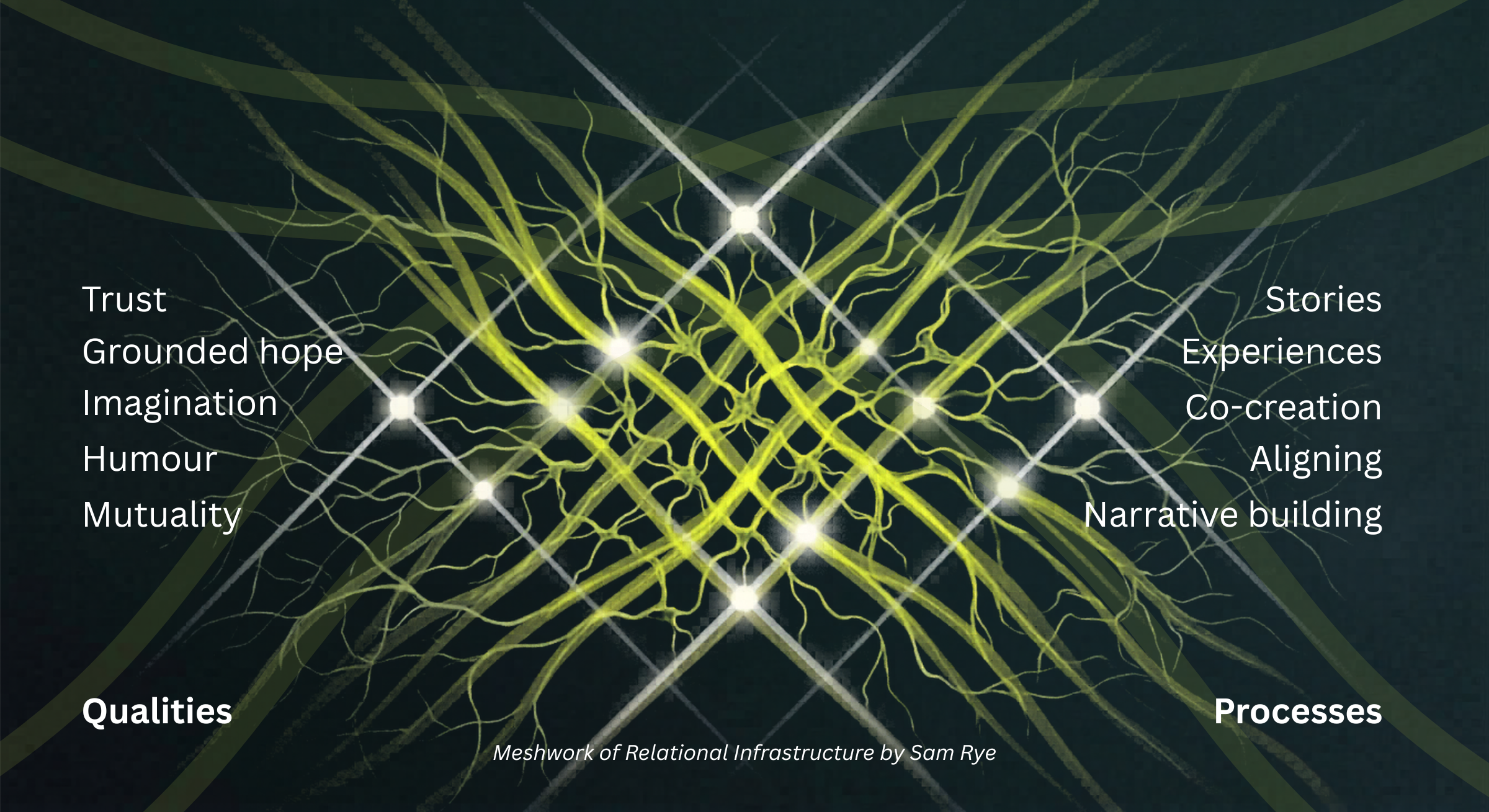
In this meshwork view, the first diagonal represents the Qualities or capabilities that the meshwork requires and produces. I'm including here:
- Trust
- Grounded hope (not naive optimism)
- Imagination
- Humour
- Mutuality
These qualities support a functional belief and active approach to generating new possibilities, with a mutuality, trust and humour which are at the core of change and systems shifting work (great podcast episode on that from Action Lab).
The second diagonal is made of Processes which activate and animate the qualities and capabilities. I'm including here:
- Stories
- Experiences
- Co-creation
- Aligning
- Narrative building
These are the active, relational interactions which create the shared experiences of working on hard things. These moments create the common touchpoints, outputs and memories that bind a group.
When these two diagonals intersect, we begin to explore the "how" of building relational infrastructure. Whilst I don't think these are exhaustive, these are based on 15+ years of experience and exploration in both cross-sectoral and organisational contexts.
In network theory, we often see trust acting as both the glue that holds us together and the accelerant that increases the effectiveness of working together in collaborative endeavours. This is one reason that there is so much concern at both polarisation in society, and decreasing trust in institutions, across neighbourhoods and in groups, at precisely the time we need more collective action.
By investing in this meshwork of relational infrastructure, we are putting a downpayment on the 'transaction costs' of collaboration, allowing us to move faster when it matters most, and creating an enduring infrastructure which can hold and support a range of outcomes.
Investing in the Meshwork of Relational Infrastructure
The meshwork serves different structural purposes depending on the context. Sometimes we are building bonding capital to deepen ties within a close-knit group. Other times, we are building bridging capital to link diverse, siloed organisations. Other times we are investing in increasing clarity and coherence, to support alignment and momentum.
Lets explore investing in the meshwork through three specific lenses:
- Place
- Process
- Prototypes
In each section below, I'll aim to bring these to life lightly with examples from both 1) cross-sectoral context - a social innovation lab, and 2) organisational context - a net zero initiative. Obviously these are meant to be illustrative - they're not examples which are unique to social innovation labs or net zero initiatives.
1. Places & Spaces
Investing in dedicated physical places and spaces can allow people to gather and experience things differently, often activating the "weak ties" at the edges or ecotones of networks or organisations where new innovation is most prevalent.
Example A: Cross sectoral context - social innovation lab
In a creative, cross-sectoral context like a Social Innovation Lab, this might mean creating "neutral ground" co-working or developing / utilising a dedicated creative studio environment where developing and delivering new services or campaigns is viable - a bit like Action Lab's Space in Edmonton, Canada.
Example B: Organisational context - net zero initiative
Larger organisations like Government departments and Universities sometime struggle to connect the dots between different internal teams or faculties, and physical environments can often serve as meeting and 'collision' points - essentially architecting the likelihood of serendipity (aka the water cooler effect). Examples might include field trips or demonstration sites - such as a Data Visualisation Control Room environments, or an 'exhibition' space for research findings (a bit like a rotating evidence safari)
2. Processes
Investing into experiences, whether they are facilitated, self guided, reflective or a hybrid mix, can help individuals and groups to create shared language, learn about one another's skills, prior experience and capabilities, navigate expectations, deepen trust and build shared touchstone experiences which support collaborative innovation over time.
Example 1: Cross sectoral context - social innovation lab
For an early stage consortia develping their social innovation lab this might involve investing into professional facilitation of expectation exploration, visioning and group agreement sessions to surface the tensions and align on directionality of a collaboratively-driven initiative. It might also involve investing in this being led outside of a traditional environment (such as a boardroom) to spark and nurture new thinking (such as a Biomimicry Walk), or hosting longer learning journeys like Huddlecraft.
Example 2: Organisational context - net zero initiative
Investing in processes in the organisational context is normally easier but often less well understood depending on the culture of the organisation. There is often an assumption that "one team" culture will apply, and so organisations jump straight to outputs and outcome work - a kick off meeting where people briefly share their name and team, then are expected to get straight into the work of architecting a project without really knowing anyone around the table. Instead, investing into processes might look like spending a few hours unpacking previous net zero initiatives and people's experiences (such as with the Relationship Project's Permissions Toolkit), or exploring hope, boundaries and expectations through a project pre-mortem.
3. Prototype(s)
We need tangible assets to remind us of what is possible, to move our thinking forward - call them boundary objects, artefacts, collaborative art, prototypes or whatever you like - but they are physical manifestations of the relationships and collaborative outputs. This could be visual facilitation that mirrors a group's identity back to them, the outline of a pilot project, a worked through experimentation canvas, a website or many other things.
Example 1: Cross sectoral context - social innovation lab
The social innovation lab already has a bias for action, and sometimes you have to rein in people running off with their ideas too fast! That said, the role of physical documentation or a prototype as a means to express and align on the ideas of a group, and then out into the world, cannot be understated. I've written a fair bit about experimentation over the years - you might also want to look at the rich vein of work from Liz Sanders on making in codesign. More about evaluating social innovation prototypes here from SI Canada.
Example 2: Organisational context - net zero initiative
Investing into artefacts / prototypes in the organisational context can help to clarify, align, promote co-creation and surface discontent or challenges with suggestions. In the case of the net zero initiative, we may utilise digital prototypes of organisational web pages or apps (e.g. with Claude) as a means to highlight aspects such as team accountability, content approvals, and ongoing maintenance which must be worked through for the initiative to gain broad support. Likewise we might shift documents which normally live in a digital realm into large format printed physical versions for workshops so that they can be cut up, annotated, rewritten and the likes, to promote collaboration across teams which have net zero sections of accountability or expertise. Nesta shared some useful resources on prototyping in organisations here.
Summing up
These prototypes and artifacts are not just outputs, they are feedback loops. When we look at a map of our shared skills or a visual drawing representing a hard conversation, the artifact mirrors our progress and understanding back to us.
Done well, investment into the meshwork of relational infrastructure develops and reinforces our trust and hope, strengthening all of the strands of the meshwork - or perhaps at best, creating resonance which amplifies the effectiveness across a range of measures.
Whether we are transitioning a campus to net zero or running a social innovation lab on community housing, we are working with these intersections of qualities and processes to create and nurture something that lasts and creates multiple forms of value and new possibilities in return.
References
[1] Ingold, T. (2016). Lines: A brief history. Routledge.
More to come.